
Uncategorized Archives - Silmi Law Firm

When Time Is Not on Your Side: Standing With a Mother in Detention During her Son’s Death

Earlier this year, Silmi Law’s attorney Sarah Takyi-Micah represented a Maryland mother who was taken into ICE custody while her teenage son was critically ill with cancer. Within days of her detention, his condition worsened rapidly. What followed was a race against time that no family should ever have to endure.

The Human Impact of Immigration Detention

When our office was contacted, the urgency was immediate. A 15-year-old U.S. citizen was in the hospital, and his mother, his primary source of comfort, was being held in federal detention. Medical providers warned that his time was extremely limited.

In moments like these, immigration law becomes more than statutes and procedures. It becomes about compassion, discretion, and humanity.

We made urgent efforts to communicate with detention officials and advocate for her temporary release so she could be at her son’s bedside. Tragically, before that could happen, her son passed away.

Delivering that news to a detained mother, separated by glass, is something no attorney ever forgets.

Transfers and Legal Coordination Across State Lines

In the days that followed, the situation became even more complicated. Despite initial assurances regarding her location, she was transferred out of state. Locating her and coordinating legal efforts across jurisdictions required persistence, collaboration, and support from members of the community and elected officials.

Ultimately, she was released on bond in time to attend her son’s funeral and grieve with her family.

No legal outcome can undo what happened. But ensuring she could be present for her child’s memorial mattered deeply to her and to us.

Public Statements and the Legal Record

Since then, public statements have been made regarding her immigration history. As her legal representatives, we emphasize that immigration records and court filings must speak for themselves. Allegations regarding prior entries or removals should always be carefully examined within the proper legal process.

Immigration cases are often more complex than a headline or a press release suggests.

Considering Self-Deportation and Future Proceedings

Our client is now evaluating her options moving forward, including the possibility of self-deportation.

“If she feels that this journey would be better for her to go back to her home country so she can heal and start a new life, start fresh from this, I guess that is ultimately her decision as to what she wants to do,” Attorney Sarah Takyi-Micah said.

She also noted that other legal options remain available to her client.

Because she was detained and is now released on bond wearing an ankle monitor, she must go through a formal process involving the immigration court before departing the United States.

“Especially when you’re supposed to do ICE check-ins and future hearings,” Takyi-Micah said.

A Reminder About Due Process and Dignity

This case underscores a broader reality. Immigration enforcement actions have real human consequences. Behind every case file is a family. Behind every removal proceeding is a story.

We understand that immigration policy generates strong opinions. Compassion and due process should not be secondary considerations.

At Silmi Law, we will continue to advocate for our clients with professionalism, integrity, and humanity, especially when time is not on their side.

Note: This story is shared with consent of the client and for informational purposes and does not constitute legal advice.

 

A Major EB-1A Court Win Brings New Hope for High-Skill Professionals Facing Long Green Card Delays

If you’re a highly skilled professional working in the U.S.—in software, AI, semiconductors, energy, data, or advanced engineering—you may feel like you’ve done everything right and yet your future still feels uncertain.
You’ve built real expertise.
You’ve contributed to innovation.
You’ve helped move technology, products, or systems forward.
And still, year after year, immigration delays keep your life in limbo.
A new federal court decision issued on January 28, 2026 brings an important—and very real—reason for renewed hope, especially for professionals stuck in long employment-based backlogs or facing discouraging EB-1A denials.

What Just Happened?

In Mukherji v. Miller, a federal judge ruled that USCIS improperly denied an EB-1A petition and went a step further than usual:

The court ordered USCIS to approve the petition.

This wasn’t a technical remand or a procedural reset. The judge found that USCIS relied on a “final merits determination” framework that was never lawfully adopted—and used it to deny an applicant who had already met the required EB-1A criteria.

That finding has serious implications for many professionals who were told:

“You meet the criteria, but you still don’t qualify.”

Why This Matters to So Many High-Skill Workers

Across industries—especially technology and innovation-driven fields—many professionals have faced the same frustration:

  • ✦Strong credentials
  • ✦Meaningful contributions
  • ✦Peer recognition
  • ✦Real-world impact

Yet USCIS often dismisses that evidence with vague language at the final stage.

In this case, USCIS acknowledged the applicant met more than the required number of EB-1A criteria, but denied anyway—arguing that her recognition was not sufficiently “sustained.”

The court rejected that reasoning.

The Judge Made Several Critical Points:

USCIS cannot invent new requirements beyond the statute and regulations

  • ✦ There is no law requiring someone to remain permanently “at the top” of their field year after year
  • ✦ Policy changes that affect eligibility must go through proper rulemaking
  • ✦ Courts—not agencies—decide questions of law

And when USCIS fails to explain why strong evidence is supposedly insufficient, that decision can be overturned.

Why This Is Especially Meaningful Right Now

For professionals caught in long employment-based backlogs—many of whom have spent a decade or more on temporary visas—EB-1A often represents the only realistic path forward.

This ruling doesn’t promise automatic approval for everyone. But it does confirm something crucial:

The system is not closed. And denials are not always final.

When USCIS goes beyond the law or applies subjective standards inconsistently, federal courts can and do step in.

If Your EB-1A Was Denied—or Feels Out of Reach

You may want to take a closer look if your case involved:

  • ✦Meeting 3 or more EB-1A criteria but still being denied
  • ✦“Final merits” language that felt vague or moving-target
  • ✦of technical, internal, or innovation-based contributions
  • ✦Overemphasis on publicity rather than real-world impact
  • ✦Claims that your recognition wasn’t “recent enough”

In the post-Chevron legal landscape, those denials are far more vulnerable than they used to be.

A Note on Hope (Without False Promises)
This decision doesn’t mean every high-skill professional qualifies for EB-1A.
It doesn’t mean litigation is right for everyone.
But it does mean that talented professionals are no longer powerless when the rules are misapplied.
For many people who had begun to lose hope—especially those who’ve built their careers, families, and futures here—this ruling is a reminder:

There is still a lawful path forward.

How Silmi Law Can Help
At Silmi Law, we work with accomplished professionals across fields including:

  • ✦software and platform engineering
  • ✦AI, data, and applied research
  • ✦semiconductors and advanced hardware
  • ✦energy, infrastructure, and systems innovation
  • ✦cybersecurity, reliability, and large-scale technical leadership


We help clients assess:

  • ✦whether EB-1A is viable
  • ✦how to structure evidence effectively
  • ✦and when challenging a denial in federal court makes strategic sense

If you’ve been waiting, discouraged, or told “no” without a clear explanation—now may be the right time to take a second look.

Schedule a consultation with Silmi Law

 Your career didn’t stall. The system did—and courts are starting to correct that.


2026 Immigration Outlook: What USCIS Strategy Really Requires Now

As 2025 came to a close, immigration uncertainty did not slow down, it intensified.

In a year-end YouTube live session, immigration attorney Sharif Silmi addressed what many highly skilled professionals are quietly experiencing:

More scrutiny.
More unpredictability.
And more pressure,  even for individuals who have followed every rule.

The key takeaway from that discussion was clear:

You can no longer rely on rumors, forums, or surface-level interpretations of the Visa Bulletin.
You need a strategy grounded in how USCIS actually makes decisions.

Below are the five most important insights from that session,  and why they matter heading into 2026.


1. The Visa Bulletin Is Not the Full Story

Many professionals track the monthly Visa Bulletin and assume it alone determines when they can file Adjustment of Status.

That assumption is incomplete.

While the State Department publishes the Visa Bulletin, USCIS decides which chart controls filing eligibility, either:

  • Dates for Filing, or

  • Final Action Dates

And USCIS can change this determination month to month, depending on internal workload and policy considerations.

Why this matters:

  • Two applicants with identical priority dates can face very different outcomes

  • Filing windows can open, or close, with little notice

  • Strategic timing requires understanding both charts, not just one

A misread bulletin can delay your case by months or even years.


2. EB-1 “Porting” Opportunities Can Appear Suddenly

For professionals stuck in EB-2 or EB-3 backlogs, there may be moments where an EB-1 strategy creates forward movement, but only if you understand how the charts interact.

In certain scenarios:

  • Prior EB-2 or EB-3 time can be leveraged

  • EB-1 categories may advance faster

  • Filing windows may briefly open

These opportunities are often short-lived and missed by applicants who are not actively monitoring USCIS interpretations.

Key point:

EB-1 strategy is not about eligibility alone, it’s about timing and alignment with bulletin movement.


3. Self-Petition Categories May Face Tighter Evidence Standards in 2026

Categories like EB-1A (Extraordinary Ability) and National Interest Waiver (NIW) are not disappearing.

But what may change is:

  • The type and quality of evidence USCIS expects

  • How officers evaluate examples within existing frameworks

The legal standards remain the same.
The interpretation of “persuasive evidence” may tighten.

Practical implication:

  • Waiting to “see what happens” can weaken your position

  • Early preparation allows time to build verifiable, objective documentation

  • Strong cases are built over time, not rushed after policy shifts

If you are even considering EB-1A or NIW, preparation in advance is increasingly important.


4. Team-Based Work Is Still Valid Despite Online Myths

A growing myth claims:

“If you didn’t work alone, you can’t qualify for EB-1A or NIW.”

This is incorrect.

U.S. immigration law explicitly allows for:

  • Team-based contributions

  • Critical or leading roles within organizations

  • Collaborative work that produces nationally or internationally significant impact

USCIS cannot invent new standards beyond the regulations.

The issue is not whether you worked on a team, it’s whether your role was essential, distinguished, and well-documented.


5. AI Does Not Replace Evidence and Can Weaken Cases

AI tools can help with drafting.

They cannot:

  • Create achievements

  • Replace documentation

  • Substitute for verifiable proof

Letters without supporting evidence are not persuasive, they are noise.

Strong petitions are built on:

  • Objective documentation

  • Independent validation

  • Clear linkage between work and impact

AI can assist the process, but it cannot build the foundation of a case.


The Human Reality Behind the Strategy

Beyond policy and charts, 2025 carried real consequences for many professionals:

  • H-1B travel disruptions

  • Delayed visa stamping appointments

  • Families separated

  • Careers paused

These pressures are exactly why more individuals are now exploring:

  • EB-1A

  • NIW

  • O-1A-first strategies

Not out of panic but out of the need for control and predictability.


Why Strategy Matters More Than Ever in 2026

If you’re entering 2026 feeling uncertain, here is the most honest advice:

Do not wait until the system forces you to react.
Build a strategy now while you still have options.

Immigration outcomes increasingly favor those who plan early, document thoroughly, and understand how USCIS actually operates.


Watch the Full Year-End Immigration Strategy Session

Sharif Silmi breaks down these issues in detail during his year-end YouTube live session, including real-world examples and chart analysis.

 Watch the full session here


Ready to Map Out Your Best Immigration Pathway?

If you would like Silmi Law to review your situation and design a strategy aligned with your goals:

Book a Consultation

And if you know someone:

  • Stuck in EB-2 or EB-3 backlog

  • Dealing with stamping delays

  • Confused by the Visa Bulletin

Share this article with them. It could save them months or years.

EB-1A Critical Role Does Not Require Working Alone: How Team-Based Contributions Satisfy USCIS Standards

One of the most common misconceptions I encounter in EB-1A cases is the belief that a beneficiary must have worked alone, or exercised formal managerial authority, to qualify under the “critical role” criterion. This misunderstanding frequently leads otherwise strong candidates to undervalue their record or worse, to frame their evidence in a way that invites unnecessary scrutiny from USCIS.

The law does not require isolation. It requires impact.

This article explains how team-based work can and often does satisfy the EB-1A critical role standard, so long as the evidence demonstrates that the organization relied on the beneficiary’s specified expertise for initiatives central to its mission.

Also note, when considering whether one performs in a “Leading Role” this requires an alternative analysis and is subject to a different legal standard that will be addressed in a separate article. 

What the EB-1A “Critical Role” Criterion Actually Requires

Under 8 C.F.R. § 204.5(h)(3)(viii), a petitioner may satisfy the EB-1A criteria by showing that the beneficiary:

“has performed in a leading or critical role for organizations or establishments that have a distinguished reputation.”

USCIS policy guidance makes clear that the inquiry focuses on function and impact, not job title. Specifically, for a critical role, officers are instructed to examine whether:

“the person has contributed in a way that is of significant importance to the outcome of the organization’s activities.”

Notably absent from the regulation are any requirements that the beneficiary:

  • Worked independently

  • Was the sole contributor

  • Managed employees

  • Held executive authority

These are extra-regulatory requirements, and courts have repeatedly cautioned USCIS against imposing them.

Teamwork Does Not Defeat a Finding of a Critical Role

USCIS guidance and AAO decisions recognize that modern innovation is collaborative. Large-scale projects—particularly in technology, business, science, healthcare, and engineering—are rarely executed by one individual acting alone.

The question is not whether the beneficiary worked on a team.
The question is whether the organization depended on the beneficiary’s expertise.

AAO non-precedent decisions consistently reflect this principle:

  • AAO Decision (June 7, 2016)
    The AAO found a critical role where the beneficiary architected and drove core technical programs relied upon by a distinguished organization, despite the involvement of large teams.

  • AAO Decision (April 18, 2017)
    The AAO explicitly rejected the notion that collaboration precludes a finding of a critical role, emphasizing that the beneficiary’s expertise was integral to key outcomes.

  • AAO Decision (October 22, 2019)
    The AAO recognized a critical role based on strategic influence and organizational reliance, even though the beneficiary did not exercise formal managerial authority.

Taken together, these decisions reflect a consistent analytical framework:
criticality is measured by reliance and outcome, not exclusivity.

Federal Courts: USCIS Cannot Add Extra Requirements

Federal courts have been equally clear that USCIS may not raise the evidentiary bar beyond what the regulation requires.

In Kazarian v. USCIS, the Ninth Circuit held that USCIS errs when it:

“unilaterally imposes novel substantive or evidentiary requirements beyond those set forth in the regulations.”
596 F.3d 1115, 1121–22 (9th Cir. 2010)

Similarly:

  • Rijal v. USCIS rejected USCIS’s discounting of detailed expert testimony and emphasized that adjudications must remain tethered to the regulatory text.
    772 F. Supp. 2d 1339, 1346–47 (W.D. Wash. 2011)

  • Buletini v. INS confirmed that eligibility need only be established by a preponderance of the evidence, not by proof of exclusive or singular responsibility.
    860 F. Supp. 1222, 1230 (E.D. Mich. 1994)

These cases are particularly important in critical-role adjudications, where USCIS sometimes conflates “important contributor” with “replaceable team member.” The law does not support that conflation.

How to Properly Document a Critical Role in Team-Based Work

In team-based EB-1A cases, the evidentiary focus should be on organizational reliance, not headcount. Effective petitions typically demonstrate:

  • The initiative was central to the organization’s mission or operations

  • The beneficiary’s expertise was specialized and not fungible

  • Leadership or stakeholders relied on the beneficiary’s judgment

  • The project’s success depended on decisions, architecture, strategy, or problem-solving driven by the beneficiary

  • Comparable initiatives would not have achieved the same outcome without the beneficiary’s involvement

Importantly, this showing can be made without asserting sole authorship, being an inventor or having managerial control. In many cases, those assertions weaken credibility rather than strengthen it.

Key Takeaway for EB-1A Applicants

Teamwork is not a liability in EB-1A cases.
Mischaracterizing teamwork is.

When framed correctly, collaborative work often provides stronger evidence of a critical role because it highlights that a distinguished organization chose to rely on the beneficiary’s expertise within complex, high-stakes initiatives.

The EB-1A classification is about extraordinary ability, not isolation. USCIS is required to evaluate the significance of the role performed, not whether the beneficiary stood alone.

About the Author

Sharif Silmi is an immigration attorney focusing on EB-1A extraordinary ability and National Interest Waiver and Investor petitions using a qualitative, statute-driven approach. His practice emphasizes aligning evidence with the plain language of the regulation and established federal case law.

Frequently Asked Questions: EB-1A Critical Role and Team-Based Work

Can team-based work qualify for the EB-1A critical role criterion?

Yes. USCIS recognizes that a beneficiary may satisfy the critical role criterion where the organization relied on the beneficiary’s specialized expertise for initiatives central to its mission, even if those initiatives involved teamwork.

Does working with large teams undermine an EB-1A critical role claim?

No. The relevant inquiry is not whether the beneficiary worked alone, but whether the beneficiary’s role was of significant importance to the outcome of the organization’s activities.

Do I need to be a manager or have direct reports to prove a critical role?

No. A critical role may be established through strategic influence, architectural responsibility, or specialized expertise, even without formal managerial authority or executive title.

What does USCIS look for when evaluating a “critical role”?

USCIS examines whether the organization relied on the beneficiary’s expertise in a way that materially affected key outcomes, core initiatives, or mission-critical operations.

What evidence is most persuasive in team-based critical role cases?

Strong cases include detailed employer letters explaining organizational reliance, supported by documentation showing the beneficiary’s responsibility for core decisions, strategy, or execution within high-impact initiatives.

Does USCIS require proof that I was the only person who could do the work?

No. The EB-1A regulation does not require exclusivity. Federal courts have made clear that USCIS may not impose extra-regulatory requirements such as sole responsibility or singular authorship.

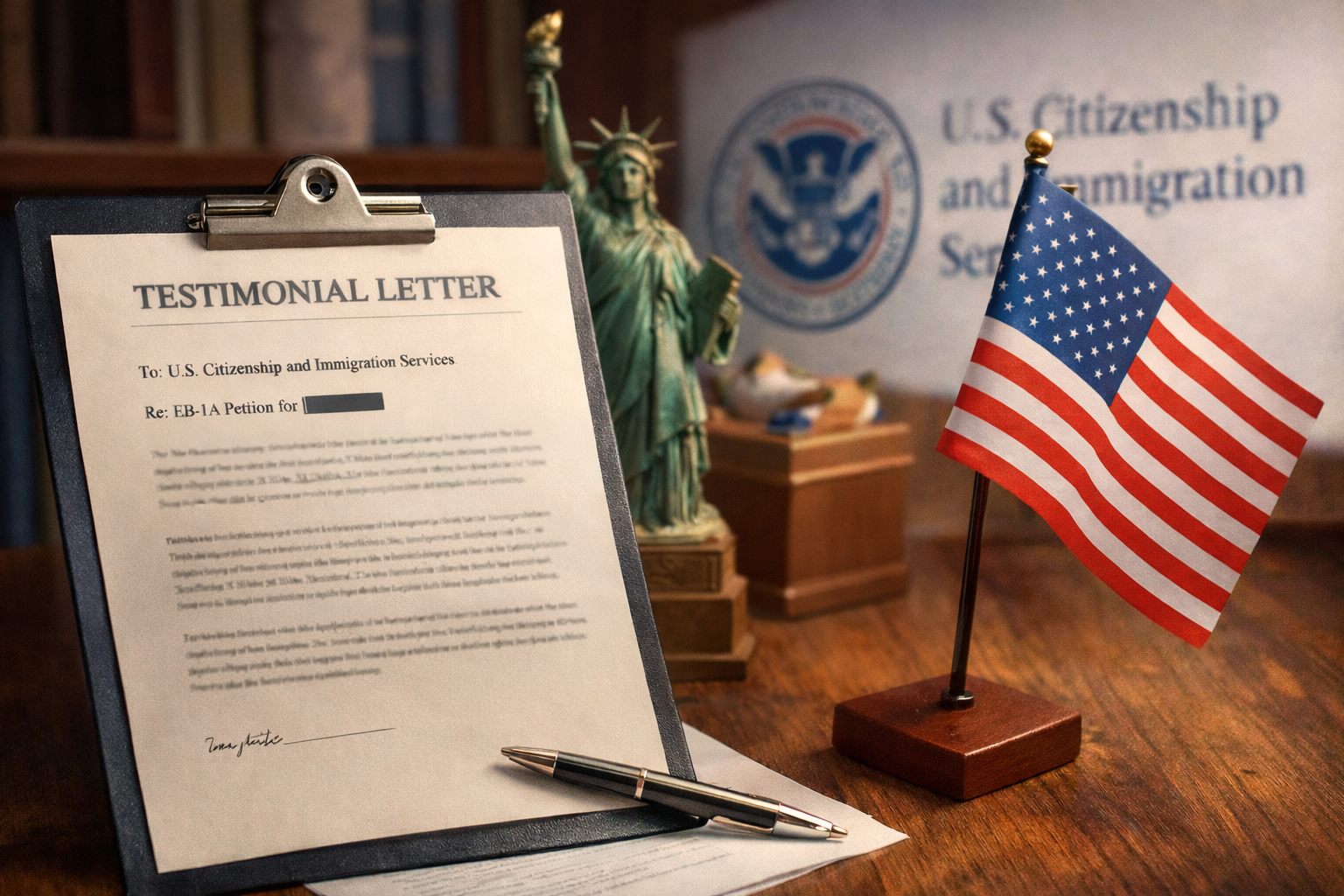
EB-1A Testimonial Letters: What USCIS Actually Looks For

USCIS does not approve EB-1A cases based on the number of testimonial letters submitted. Instead, adjudicators evaluate whether those letters demonstrate independent recognition, legal relevance, and alignment with the EB-1A final merits standard. Generic or poorly structured letters often weaken otherwise strong cases.

Testimonial letters can meaningfully strengthen an EB-1A (Extraordinary Ability) petition—but only when they are drafted with precision, strategy, and legal intent. In practice, many EB-1A cases falter not because the candidate lacks extraordinary ability, but because the testimonial evidence submitted fails to carry probative value under USCIS standards.

Below are several high-level principles to understand before pursuing testimonial letters as part of an EB-1A strategy.

1. Not All Testimonial Letters Carry the Same Weight

USCIS does not assign value to testimonial letters simply because they are positive or written by senior individuals. Officers evaluate who is writing, why they are qualified to assess the beneficiary, and how the letter supports the legal framework of EB-1A eligibility.

Letters that merely restate a résumé or offer generalized praise rarely influence the outcome of a case.

2. Independence and Credibility Matter More Than Volume

Multiple letters from closely affiliated colleagues are often less persuasive than a smaller number of well-positioned, independent testimonials. However, independence alone is insufficient, the writer must also be able to credibly evaluate the beneficiary’s impact within the field, not just within one organization.

Selecting the wrong recommender can undermine even a strong evidentiary record.


3. Each Letter Must Align With the Legal Theory of the Case

Effective EB-1A petitions use testimonial letters strategically, not interchangeably. Each letter should serve a defined legal purpose—such as supporting original contributions of major significance, leading or critical role, high remuneration, or the final merits determination.

Letters that attempt to “cover everything” often dilute their evidentiary value.

4. Tone and Structure Are Critical

USCIS adjudicators are trained to be skeptical of exaggeration. Letters that read like marketing endorsements or character references are frequently discounted.

The most effective testimonial letters are measured, professional, factual, and written as expert assessments rather than advocacy pieces.

Why a Tailored Strategy Is Essential

There is no universal template for EB-1A testimonial letters. The appropriate structure, authors, and content depend on the petitioner’s profession, evidence profile, and overall legal strategy. What strengthens one EB-1A case may be ineffective—or even harmful—in another.

Because EB-1A eligibility is highly individualized, there is no one-size-fits-all approach to testimonial letters. A case-specific strategy is essential.

Frequently Asked Questions About EB-1A Testimonial Letters

Do testimonial letters guarantee EB-1A approval?
No. USCIS evaluates testimonial letters as part of a holistic, evidence-based analysis. Letters alone do not establish eligibility.

How many testimonial letters are required for EB-1A?
There is no required number. Quality, independence, and legal relevance matter far more than quantity.

Should EB-1A testimonial letters be customized?
Yes. Effective testimonial letters must be tailored to the petitioner’s field, evidentiary record, and legal theory of eligibility.

Speak With an EB-1A Specialist Before Proceeding

If you are considering an EB-1A petition and are unsure how testimonial letters should be approached in your specific case, experienced legal guidance is critical.

This article was prepared by Silmi Law, a U.S. immigration law firm led by Attorney Sharif Silmi, whose practice focuses on EB-1A, EB-2 NIW and other employment and investment based petitions using qualitative, evidence-driven strategies.

To discuss whether you qualify for EB-1A or NIW and how testimonial letters should be structured for your case, schedule a consultation with Attorney Sharif Silmi.

Every successful EB-1A case begins with the right strategy!

EB1A Crackdown: Why USCIS Is Revoking Petitions and How to Avoid the Trap

What Indian professionals in the U.S. need to know about fake credentials, profile-building scams, and how to build a winning EB1A case with real substance.

A major controversy is unfolding in the EB1A green card space: USCIS is revoking previously approved petitions from Indian nationals who relied on fraudulent, flimsy, or purchased evidence to meet the EB1A criteria.

If you’re an Indian professional on an H-1B or considering self-petitioning under EB1A, this is your wake-up call.

As an immigration attorney who has specialized in EB1A for the past decade, I’ve been warning about this very situation for many years. I called out the dangers of paid judging roles, fake awards, and ghostwritten media when others were promoting them as “quick wins.” Now, USCIS is cracking down. And it’s not just denials — it’s revocations after approval.

The Rise of Fraudulent “Profile Building”

Too many hopeful applicants have been sold the dream of EB1A approval through what some call “profile building companies.” These agencies often promise:

  • Judging credentials from bogus awards like Globee and Stevie
  • Publications in pay-to-play “journals” with no credible peer review
  • Paid articles or media coverage ghostwritten to appear credible

These schemes may look shiny on the surface, but they fall apart under USCIS scrutiny.

I Warned You: Globee and Stevie Awards Are Not Valid EB1A Evidence

In November 2023, I posted a short video explicitly warning that Globee and Stevie judging claims are not persuasive to USCIS. These are not legitimate peer-reviewed judging opportunities and often result in inflated, unverifiable claims.

Watch the Short: “Don’t Use Globee or Stevie Awards in Your EB1A Petition”

Yesterday, I addressed the current EB1A revocation controversy in a live YouTube video, showing receipts of how I’ve been educating clients and viewers on this issue long before this wave of scrutiny began.

Watch the Live Video: USCIS Crackdown and What It Means for You

What You Should Be Doing Instead: The Qualitative Approach

My firm takes a deep, tailored approach to building EB1A cases:

  • Focus on real-world impact, not just checkboxes
  • Highlight credible peer-reviewed judging (e.g., professional review done outside of the normal course of employment)
  • Cite tangible outcomes: how your work is used, implemented, or relied on by others
  • Develop a clear and compelling narrative showing national importance

This is not about fluff. It’s about substance. And that’s what wins.

Message to Indian Professionals in the U.S.

Indian nationals are disproportionately affected because of the high number of talented professionals applying from STEM fields. That’s also why these profile-building companies have targeted you.

The truth is simple:

  • Shortcuts don’t work
  • Weak evidence won’t hold up
  • And fraudulent tactics can get your case revoked even after it’s been approved

I’ve helped thousands of professionals build real EB1A cases that win — without the gimmicks.

Now is the time to get serious.

What You Should Do Next


Attorney Sharif Silmi
Silmi Law, Experts in EB1A and NIW Immigration Strategy

Why 2025 Is the Perfect Year to Become a U.S. Citizen

In our latest YouTube Live discussion, Managing Attorney Sharif Silmi broke down the state of Green Card holders and explained why naturalization should be your next strategic move. If you hold a lawful permanent resident (LPR) card, keep reading—you could be just months away from voting, traveling on a U.S. passport, and opening new doors for your family.

Fast Facts that Should Hit Home

  • 818,500 new citizens were sworn in during FY 2024—proof that the process works when guided correctly.
  • USCIS has moved 100% of Form N-400 filing online, letting you track your case 24/7 and respond to RFEs digitally.
  • The current filing fee is $760 ($380 if you qualify for the reduced-fee option). Waiting longer won’t lower the cost—but a fee hike could always be around the corner.

5 Powerful Reasons to File Your Form N-400 Now

  1. Full Voting Rights — Shape local, state, and federal policy, including immigration reforms that affect you and your community.
  2. Security of a U.S. Passport — Travel worries disappear with consular protection and visa-free entry to 180+ countries.
  3. Family Unity — Citizens can sponsor spouses, parents, and unmarried children without the crushing backlogs faced by Green Card holders.
  4. Career & Federal Benefits — Some government jobs and contracts are open only to citizens; naturalizing also unlocks full eligibility for federal aid and grants.
  5. Protection from Deportation — U.S. citizens cannot be removed for criminal or immigration violations committed after naturalization.

Am I Eligible? Quick Self-Check

You’re likely ready to file if you:

  • Have been an LPR for 5 years (you can apply at 4 years + 9 months) (or 3 years (2 years + 9 months) if married to a U.S. citizen)
  • Have maintained continuous residence and physical presence
  • Can pass basic English and civics tests (exemptions apply)
  • Possess good moral character

Not sure? Schedule a free 15-minute consult with Silmi Law and get clarity.

What Sets Silmi Law Apart?

  • 1000+ successful naturalization cases handled across all 50 states
  • Flat-fee pricing and flexible payment plans
  • In-house translators for Spanish, Arabic, French, Urdu, Farsi, Bangla
  • Secure client portal for document uploads and real-time updates

“Silmi Law turned what felt like an uphill battle into a straightforward checklist. I was sworn in just 6 months after filing.” — Rosa M., Baltimore

Ready to Start?

Every day you delay naturalization is a day you’re missing out on the rights and security that come with U.S. citizenship. Let the experienced team at Silmi Law guide you from Form N-400 to the oath ceremony.

*Disclaimer: This blog is for educational purposes and does not constitute legal advice. Consult an attorney for guidance on your individual case.*
Does My Salary Meet EB1A Criteria? Here’s the Real Answer.