
The I-130 Approval Letter Is Not the Green Card. In 2026, That Gap Just Got Wider.
A couple married in 2023. The U.S. citizen spouse filed Form I-130. USCIS approved it in 2024: the petition that establishes a real marital relationship exists. In 2026, the same couple sat through an adjustment of status interview and received a denial.
Nothing about the marriage had changed. What changed was how USCIS is now instructed to treat the second, separate decision that comes after the petition: whether to actually grant permanent residence.
If you are planning a family-based case, or already have one pending, this is the part of 2026 immigration policy most couples do not find out about until it is too late to prepare for it.
The Legal Concept: Adjustment of Status Was Always Discretionary. USCIS Just Started Treating It That Way.
Here is the distinction that drives everything else in this post, and the one almost no one explains clearly before filing.
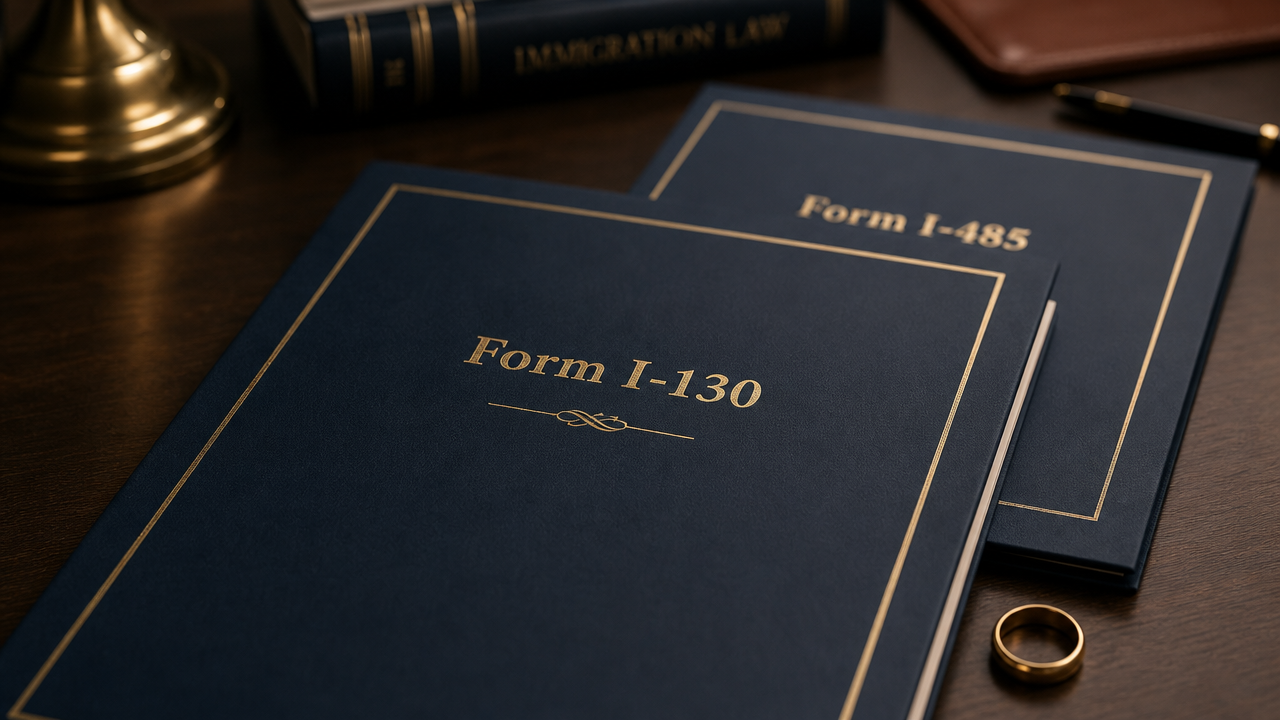
Form I-130 asks a narrow, factual question: is this a real marriage (or real family relationship) that qualifies the beneficiary as an immediate relative or preference category relative under INA § 201(b)(2)(A)(i) or the applicable preference category? Approval of the I-130 answers that question. It does not, by itself, grant any status, work authorization, or protection from removal.
Form I-485, the application to adjust status, is governed by INA § 245, and adjustment under that section has always been, as a matter of law, discretionary relief, not an entitlement. This is not new law. The Board of Immigration Appeals said as much in 1970, in Matter of Arai, 13 I. & N. Dec. 494, holding that adjustment of status is a matter of administrative grace even for an applicant who is statutorily eligible.
What changed is enforcement posture. On May 21, 2026, USCIS issued Policy Memorandum PM-602-0199, directing officers to treat adjustment of status explicitly as an “extraordinary form of relief” and to weigh adverse and favorable discretionary factors more assertively, rather than treating an approvable petition and a clean statutory eligibility case as functionally decisive on their own.
The distinction that matters: the underlying statute has not changed. INA § 245 remains in effect exactly as written. What changed is how aggressively officers are instructed to exercise the discretion the statute always gave them.
The Assumptions That Are Now Actively Dangerous
Every family-based case rests on a set of assumptions couples make going in. Several of those assumptions were always technically wrong, but the gap between “technically wrong” and “practically consequential” has narrowed sharply in 2026.
Assumption 1: “An approved I-130 means the green card is basically approved too.” Wrong, and increasingly consequential. The petition and the adjustment are two separate decisions, made under two separate legal standards, by design.
Assumption 2: “Filing the I-130 protects me from removal while it’s pending.” Wrong. A pending or even approved family petition does not itself bar enforcement action. USCIS has reiterated this point directly in public guidance this year.
Assumption 3: “Marriage automatically forgives any unlawful entry or overstay.” Partially wrong, and the details matter more than ever. Some immediate relatives who were inspected and admitted or paroled into the U.S. remain eligible to adjust despite a subsequent overstay. Entry without inspection generally presents a separate, harder adjustment problem that marriage alone does not solve.
Assumption 4: “If we’re not lying about the marriage, fraud provisions don’t apply to us.” This one deserves its own section, because the standard is narrower than most petitioners assume.
The Marriage Fraud Bar Reaches Further Than “Did You Lie”
INA § 204(c) bars approval of a petition where the beneficiary has previously attempted or conspired to enter into a marriage for the purpose of evading immigration law. Updated USCIS guidance this year reaffirmed a point that surprises many petitioners: a completed fraudulent marriage is not required to trigger this bar. Evidence of an attempt or conspiracy can be sufficient on its own.
This matters most for petitioners with a complicated immigration history: a prior marriage that ended shortly after a status benefit was obtained, inconsistent statements across prior filings, or a prior marriage-based petition that was withdrawn or denied under circumstances that were never fully explained on the record. None of that means the current marriage is fraudulent. But under the current review posture, that history is more likely to be examined closely, and more likely to be weighed as an adverse discretionary factor even where INA § 204(c) itself does not technically apply.
Discretion Now Runs on a Scale, Not a Checklist
Under the more assertive discretionary posture directed by PM-602-0199, officers are instructed to weigh favorable and adverse factors against each other, rather than treating statutory eligibility as functionally the end of the inquiry.
Favorable factors that carry weight:
- Length and depth of the bona fide marital relationship
- U.S. citizen children, especially where family separation would be severe
- Strong community and employment ties
- Full, consistent immigration history with no material misrepresentations
- Time already spent in lawful nonimmigrant status before any violation
Adverse factors weighed more heavily now:
- Unlawful entry, particularly entry without inspection
- Overstays, especially extended or repeated
- Inconsistencies across prior filings, even where individually minor
- Any prior immigration benefit fraud allegation, substantiated or not yet resolved
- Criminal history, including matters that previously might not have weighed heavily
The practical shift: a petitioner who would have been approved on statutory eligibility alone two years ago may now need the favorable side of that ledger to affirmatively outweigh the adverse side, documented and argued as its own component of the filing, not assumed to be self-evident from a genuine marriage.
Nationality Adds a Second Layer of Delay
A separate but related development is affecting a specific subset of family-based cases in 2026: petitions involving spouses from certain countries subject to heightened national-security vetting are experiencing significant, often unexplained delays: cases pulled for extended review at a centralized vetting unit, sometimes with processing effectively paused for nationals of a defined list of countries, independent of anything specific to the individual case.
For petitioners in this situation, the practical lesson is different from the discretionary-factors discussion above: the delay is frequently about nationality-based processing, not a weakness in the underlying case. That distinction matters for how a family should plan: continue to maintain lawful status where possible, avoid gaps that create new adverse factors, and do not mistake a security-review delay for a sign that the case itself is in jeopardy.
Framework: Building a Discretion-Resistant Family Petition
Before filing, or before an interview on a pending case, walk through this checklist:
- Is every immigration history detail (prior visas, prior petitions, prior marriages) consistent across every form filed to date?
- If there was an unlawful entry, has an attorney confirmed whether an exception applies (inspection and admission or parole) or whether a separate waiver strategy is needed?
- Has the favorable side of the discretionary ledger been affirmatively documented, not just implied by the marriage itself?
- If either spouse had a prior marriage that ended around the time of an immigration filing, is there a clear, documented explanation on the record before an officer has to ask for one?
- Is the petitioner or beneficiary a national of a country currently subject to heightened vetting, and if so, has the family been advised to expect delay independent of case strength?
- Has lawful nonimmigrant status been maintained wherever possible while the family-based case is pending?
If two or more boxes raise a concern, the case may be statutorily approvable and still vulnerable to a discretionary denial under the current review posture.
Case Study: Same Facts, Different Years, Different Outcomes
A couple married in 2021. The foreign spouse had entered on a valid student visa, overstayed by approximately eighteen months before the marriage, then adjusted status through the U.S. citizen spouse. The I-130 was approved in 2022, and the adjustment interview took place in early 2023. The couple’s documentation was solid but unremarkable: joint lease, joint bank account, photos, and straightforward testimony. Approved without incident.
Consider a comparable couple filing in 2026: same visa history, same eighteen-month overstay, same category of entry with inspection. Under the current posture, the same documentation package (solid but unremarkable) now sits closer to a coin flip. The adverse factor (an extended overstay) is weighed more assertively. A petition that does not affirmatively build out the favorable side of the ledger, including the depth of the relationship, community ties, any hardship considerations, and a clear account of why the overstay occurred, risks a discretionary denial despite identical facts to a case that sailed through three years earlier.
The lesson is not that overstays are now disqualifying. They are not. The lesson is that the same fact pattern now requires the case to be built, not assumed.
Frequently Asked Questions
Does an approved I-130 guarantee a green card will be granted?
No. The I-130 establishes a qualifying family relationship. The subsequent adjustment of status (Form I-485) or immigrant visa decision is a separate determination, and under INA § 245, adjustment has always been discretionary relief rather than an entitlement.
What changed with PM-602-0199 if adjustment was already discretionary?
The underlying law has not changed. The May 2026 memorandum directs USCIS officers to apply that existing discretion more assertively, explicitly weighing adverse and favorable factors against each other, rather than treating statutory eligibility as effectively decisive.
Does marriage to a U.S. citizen erase an unlawful entry or overstay?
Not automatically. Some immediate relatives who were inspected and admitted or paroled can adjust despite a later overstay. Entry without inspection generally presents a separate legal problem that a bona fide marriage alone does not resolve.
Can a genuine marriage still trigger the marriage fraud bar under INA § 204(c)?
The bar targets attempted or conspired fraud, not only completed fraud. A genuine current marriage does not automatically trigger it, but a documented history involving a prior marriage or prior filing with unresolved inconsistencies can invite closer scrutiny under the current review posture.
Why is my case delayed with no clear explanation?
Some delays in 2026 stem from centralized national-security vetting review affecting petitioners or beneficiaries from specific countries, independent of the underlying strength of the case. This is a separate issue from discretionary factor weighing and should be evaluated with an attorney familiar with current processing patterns.
What This Means for Your Case
A family-based petition used to be, for many couples, close to a formality once the marriage was genuine and the I-130 was approved. In 2026, the second half of the process, the discretionary decision, carries more independent weight than it has in years. That does not mean approvable cases are becoming unapprovable. It means the favorable side of the record now has to be built deliberately rather than assumed.
At Silmi Law, we work with families, including many where one spouse holds or previously held employment-based nonimmigrant status, to build adjustment of status cases that account for the current discretionary posture before a decision is made, not after a denial or an unexpected RFE.
Schedule a case strategy review with Attorney Sharif Silmi. In 30 minutes, we will evaluate your immigration history for discretionary risk factors, confirm whether any exception applies to a prior unlawful entry or overstay, and outline what documentation should be built before your interview.
Legal Disclaimer
This blog post is provided for informational purposes only and does not constitute legal advice. Reading this content does not create an attorney-client relationship with Silmi Law Firm.
Family-based immigration law, and adjustment of status discretion in particular, is highly fact-specific and continues to evolve through USCIS policy memoranda, including the developments discussed above. The information provided here represents general principles current as of the publication date and may change without notice.
Before taking any action related to a family-based petition, adjustment of status application, or immigration history involving unlawful entry, overstay, or a prior marriage, you should:
- Consult with a qualified immigration attorney
- Provide complete and accurate documentation of your immigration history
- Obtain written legal advice tailored to your specific circumstances
Silmi Law makes no guarantee of approval and no guarantee of the continued accuracy of the legal developments referenced in this post.
For legal representation, contact Silmi Law at:
- Phone: +1 (443) 329-2929
- Email: info@silmilaw.com
- Website: silmilaw.com


